Showing posts with label saxophone. Show all posts

Friday, January 31, 2014

Saxophone Tips & Tricks

Posture
Saxophone posture
Saxophone posture can vary depending on the musician.  Like other instrumentalists, saxophone players should sit up straight with their feet flat on the floor, but they can choose how to hold the instrument while they're playing it.  Younger players can learn to hold the saxophone so it's outside their legs.  (This is how most of our saxophone section plays.)  I'm assuming this is because they aren't big enough to hold the instrument between their legs.  I play with the saxophone rested between my legs on the chair - I'm just tall enough for it to work out.  It means I don't have to have the weight of the saxophone on my neck, which is nice.  I'm not sure if this is encouraged for elementary school students; that's something to figure out in April.

Saxophone embouchure
Embouchure
The saxophone mouthpiece was based on the bass clarinet's, so the embouchure is similar.  The mouthpiece goes straight into the mouth, unlike clarinet mouthpieces which are at an angle.  The bottom lip can be curled under slightly, and the top teeth should apply some pressure.  The chin is flat and pointed.  The higher notes require tighter embouchure and control so they will speak and be in tune.  The mouth and throat need to be open in order to play the lower notes, as if a golf ball is in your throat.  Dropping your jaw helps open up the embouchure.

Tuning
Saxophone mouthpiece
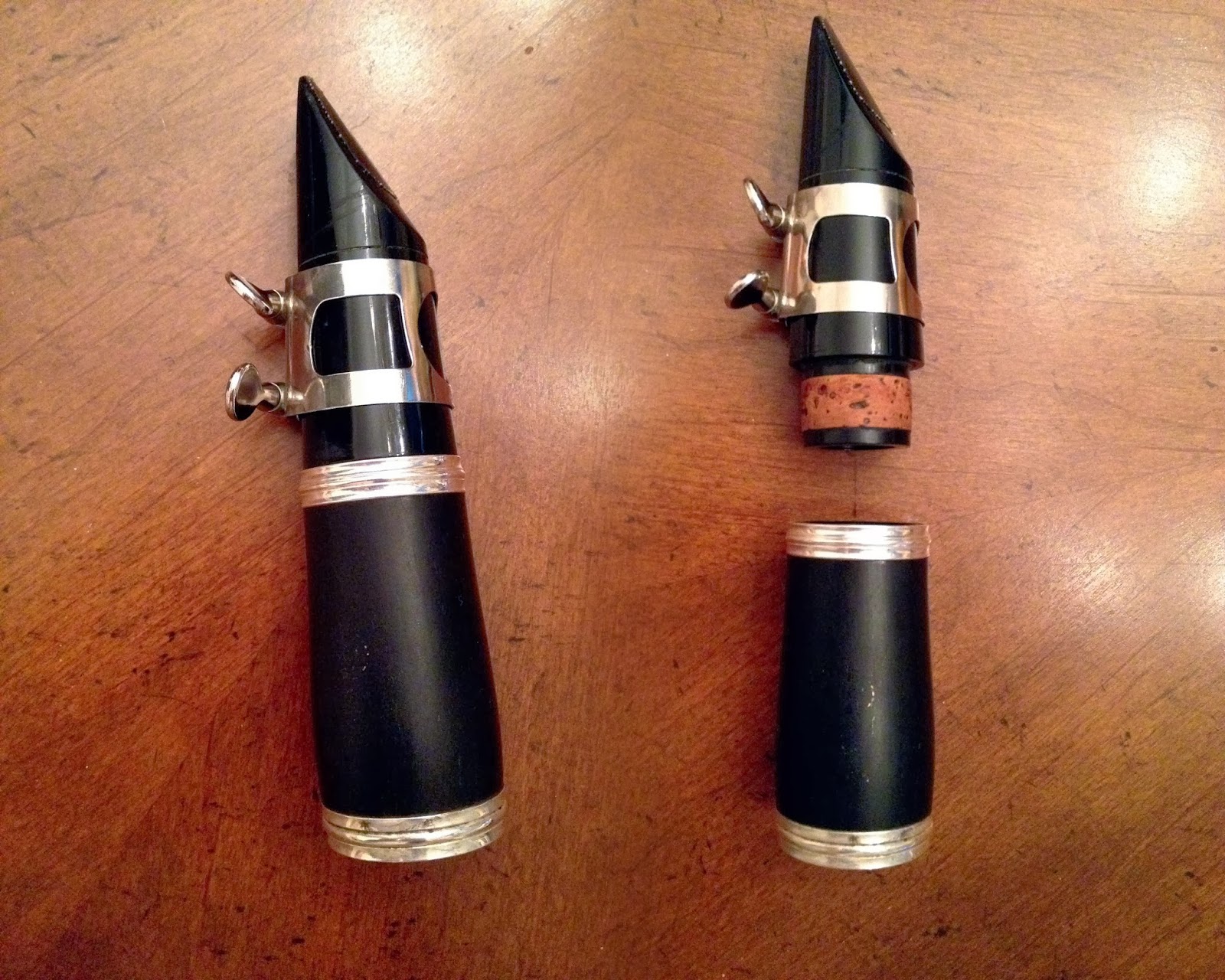
To me, the saxophone is notorious for being out of tune.  Fortunately, it can be easier to fix than on other instruments.  The mouthpiece of a saxophone is very different than other woodwind mouthpieces.  A clarinet or a flute is played with the mouthpiece pushed in all the way; there is no cork showing.  There is a definite "starting point" for tuning.  There isn't a clear "starting point" for saxophone.  The mouthpiece is placed on a piece of cork (it can safely rest on about 2 inches of it), so there's a lot of wiggle room.  You remember where to put the mouthpiece once you have some experience.  In the meantime, it's a good idea to tune before you play to ensure the mouthpiece is in the right place.  (My rented saxophone also has a red line drawn where the mouthpiece should be placed.)

Dynamics
Clarinet mouthpiece
Saxophones are also known for being able to overpower other instruments.  (I remember the saxophonists had to put socks in their bells to muffle the sound.)  They have to be able to fit in with all types of ensembles, so dynamic control is very important.  Some ranges (ie. the higher notes) are easier to play quietly than others (the lower notes), so you have to adjust your air support accordingly.  The lower notes require more support if they're going to be played quietly.

Sunday, January 19, 2014

Saxophone in band

I played the saxophone in band twice last week.  Having very similar fingerings was very convenient since I could play the music without thinking too much about it.  Whatever differences there were, I had gotten used to them.  The biggest thing I realized is how out-of-tune our saxophones really are.  Really.  Okay, my intonation wasn't perfect (you have to play an instrument for a long time in order to figure out how to adjust each individual note), and I already knew saxophones are prone to being out of tune because of the way the mouthpiece is set up, but the pitch beats were even more audible when I was among them.  I also can't hear anything the woodwinds are playing, which is something I'm not used to.  The saxophone is definitely not a graceful instrument, but it's still interesting.  Other than the intonation, it went really well.  I might bring the saxophone to a pep band game or two so I can get video footage of myself playing.  I'm glad I rented a sax from Bethel.  It's more in tune, and the lower notes are easier to get out.

Sunday, January 5, 2014

Saxophone progress

Saxophone has gotten a lot easier now that I'm used to the differences in the fingerings.  First, a few notes (ha!) on dynamics.  I’m getting better at having the control to play quietly, but it’s easier on some parts of the range than others. (I don’t know if the saxophone has names for the different sections as the clarinet does. The clarinet is known for how its registers each have a different sound, so maybe that’s why they have different names. That's something to research.) The notes that only use less than half of the saxophone (G to C#) are a lot harder to play quietly. Mrs. Harvison referred to a “change in air pressure” when I try to play quietly, probably especially in this range. When more of the saxophone is used, as in the D to G above the staff, dynamics require as much control as I am comfortable using on the higher registers on the clarinet now. Maybe a little more. The notes above a G above the staff become harder again.
The 20-minute attempt to get the mouthpiece to work (long story.)
I’m also having trouble getting in tune. It could be the instrument, or the fact that I’m not using the mouthpiece made for my particular instrument. It’s a lot more than knowing to lip the pitch up a bit when I’m playing higher - it’s really flat. And being flat (as opposed to being sharp) is really annoying since it’s harder to fix. I’m going to have trouble recording myself if I can’t play in tune! Today I'll be picking up another instrument at Bethel Music Center (Route 7 won't have any until tomorrow) just so I can have a half-decent instrument.  After all, as Allie and Mrs. Harvison say, big student instruments have a bad reputation.  I plan on being a saxophonist in band on Tuesday.  Yay, pep band!

Finally, I got the score for "Down a Country Lane" a few weeks ago and copied all of the parts into a PDF document.  I'll have to cover parts for instruments I'm not playing (ie. play the bassoon part on bass clarinet), so I created a list of instruments I'll have to record more than once.  This will also test my transposing skills.

Friday, December 20, 2013

History of saxophone

The saxophone was invented by Adolphe Sax as an attempt to improve the ophicleide, an instrument from the early 1800s.  The ophicleide, a standard orchestra instrument, was a keyed brass instrument with a trombone-style mouthpiece.  Although it had power and good tone quality, erratic intonation and inconsistent execution left room for improvement.  Adolphe Sax aimed to keep the body but remodel the keywork and add a bass clarinet-like mouthpiece.  Today, the saxophone's powerful tone and flexibility makes it a popular instrument in bands, particularly military bands.  (The alto saxophone was established as a solo jazz instrument by the 1920s.)  It is one of the most flexible instruments in terms of color and articulation, as much of its variation is in the hands of the player.
From left: soprano, alto, tenor, and baritone saxophones

Sax applied for 14 different patents in 1846, and the standard saxophone family (sopranino, soprano, tenor, alto, baritone, and bass) was established in 1850.  (The contrabass saxophone is a rare extra.)  It's considered a "hybrid instrument" because it doesn't exclusively fit in with the woodwinds or brasswinds.  Its key system is derived from, but not the same as, the flute's and clarinet's.  There are between 22 and 24 notes holes, all of which are covered by keypads.

Different saxes have the same basic range (two octaves, plus an augmented fifth) but in different transpositions.  For example, the alto sax has a compass of db to a'' and the tenor sax has a compass of Ab to e''.

The alto saxophone's compass

Thursday, December 12, 2013

Clarinet/Trumpet/Saxophone

Lessons learned this week:
1.  You don't really realize the effect of having a mouthpiece in your mouth until it isn't there anymore.
2.  Trumpet and clarinet are more similar than I initially imagined.
3.  Saxophone fingerings are the same as clarinet fingerings 90% of the time.

Here's the latest on the trumpet: Jingle Bells!  I was feeling festive.  I've finally figured out how to tongue properly.  Who knew that I would depend so much on having a physical mouthpiece in my mouth?  No part of the trumpet actually go into your mouth, so I had no clue what to ricochet my tongue off of when I played.  Until today.  I learned to treat the back of my bottom teeth as a place to aim my tongue.  It's working pretty well.

I also had a few (possibly coincidental) realizations between trumpet and clarinet.  A few of the fingerings for trumpet match the fingerings in the right hand for clarinet.  I'd be interested in learning if these similarities are deliberate.  Also, while switching partials on trumpet raises the pitch by a fifth (sometimes), pressing the register key on the clarinet raises the pitch by an octave and a fifth.  Just some cool things I noticed.

I brought a saxophone home last week, but admittedly didn't have time to play it until yesterday.  Even then, there was something wrong with the mouthpiece so the reed had no room to vibrate.  I swapped it with the mouthpiece from another case when I had a lesson with Mrs. Harvison today, and it worked fine.  Weird.  Why would they make mouthpieces that don't work?  Now it's really easy to play.  The lower notes require more air, and I have to lip up the higher notes.  (As of now, I can play from f' to g".)  Like I mentioned earlier, 90% of the fingerings are the same from what I've learned so far.  This will be explained in the Saxophone History post I'll make later on.