Here's the second chromatic scale on the trumpet. It's at 50 bpm, and I didn't look at the fingering chart. Remembering the fingerings was harder when I was descending the scale than ascending.
Second chromatic scale
Showing posts with label trumpet. Show all posts
Showing posts with label trumpet. Show all posts
Tuesday, January 7, 2014

Monday, January 6, 2014
Trumpet chromatic scale (Part 1)
I'm going to play the chromatic scale on the trumpet twice. This is the first recording, where I'm looking at the fingering chart and the beat is 50 bpm. The second recording will be without the fingering chart, and most likely at 40 bpm. Here's the first recording.
Wednesday, January 1, 2014
Trumpet Tips & Tricks
It didn't take me very long to realize how different brass instruments are from woodwind instruments. The hardest part was adjusting to the embouchure.
Embouchure
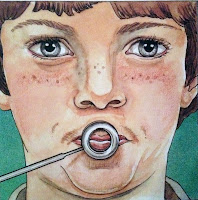 I had listened to Mr. Klepacki talking to the brass section over the years, so I wasn't completely oblivious when I started learning brass embouchure. My first actual "lesson" came from the Standard of Excellence book. It had a great explanation, and I picked it up really quickly. To find your mouth, shape the inside of your mouth as if saying "oh." Then, bring your lips together as if saying "em." The key is for the corners of your lips to be firm, but the center should be relaxed in order to create the buzz. Your chin should be flat and pointed. I discovered that buzzing relies on the firm lips; without them, I'd just blow air through pursed lips. Mr. Klepacki also recommended offsetting your lips on the mouthpiece (60/40) to make it easier.
Partials
The Standard of Excellence book was written as if a student's first note could either be the C below the staff or the G in the staff. I first played the C, so I had to work from there. One of the most important things I learned was, "You have to play low to be able to play high." The lower partial came fairly easily, but control is essential. My lower partial was usually flat, so I had to lip it up. This was done by adjusting my lips or chin.
I started moving up the C major scale once I could play below the staff. C through E came fairly easily, but it took a while to get to the G. After that, the new goal was the C in the staff. The key is to tighten your lips and blow harder. I couldn't try to estimate how much air I would need, because I would always be wrong. Have no mercy. I also found it helpful to put more pressure on the mouthpiece. This aided in tightening my lips. I don't know if a trumpet player should actually do this, but it worked for me.
Finally, I wouldn't be capable of my current range (a little under two octaves) without the practice time I put in. Seriously. Every little bit helps. PRACTICE. There's no excuse not to. It helps your embouchure's strength and endurance so you can play higher and for a longer period of time. You'll also have more control over the instrument. Each note is different; one may be slightly flat for you, but the next will be sharp. Muscle memory will develop faster with practice!
Embouchure
 I had listened to Mr. Klepacki talking to the brass section over the years, so I wasn't completely oblivious when I started learning brass embouchure. My first actual "lesson" came from the Standard of Excellence book. It had a great explanation, and I picked it up really quickly. To find your mouth, shape the inside of your mouth as if saying "oh." Then, bring your lips together as if saying "em." The key is for the corners of your lips to be firm, but the center should be relaxed in order to create the buzz. Your chin should be flat and pointed. I discovered that buzzing relies on the firm lips; without them, I'd just blow air through pursed lips. Mr. Klepacki also recommended offsetting your lips on the mouthpiece (60/40) to make it easier.
Partials
The Standard of Excellence book was written as if a student's first note could either be the C below the staff or the G in the staff. I first played the C, so I had to work from there. One of the most important things I learned was, "You have to play low to be able to play high." The lower partial came fairly easily, but control is essential. My lower partial was usually flat, so I had to lip it up. This was done by adjusting my lips or chin.
I started moving up the C major scale once I could play below the staff. C through E came fairly easily, but it took a while to get to the G. After that, the new goal was the C in the staff. The key is to tighten your lips and blow harder. I couldn't try to estimate how much air I would need, because I would always be wrong. Have no mercy. I also found it helpful to put more pressure on the mouthpiece. This aided in tightening my lips. I don't know if a trumpet player should actually do this, but it worked for me.
Finally, I wouldn't be capable of my current range (a little under two octaves) without the practice time I put in. Seriously. Every little bit helps. PRACTICE. There's no excuse not to. It helps your embouchure's strength and endurance so you can play higher and for a longer period of time. You'll also have more control over the instrument. Each note is different; one may be slightly flat for you, but the next will be sharp. Muscle memory will develop faster with practice!
Posture
 I realized the most beneficial posture isn't what I've seen the other trumpet players doing in band. Most hold their trumpets down so the bell is in the stand. I've heard how that muffles the sound, but I discovered that it actually makes the instrument harder to hold. When I began playing, I naturally held the trumpet up. My neck was straight, and it was a lot easier to exhale. I tried holding the trumpet the way others do in band, but I couldn't. My airway was restricted, and my arms were put in an awkward position. Moral of the story: don't be lazy when holding a trumpet, even when you're just beginning. It'll pay off in the long run. As always, if you're not used to sitting up straight, don't give up. Soon, you'll be sitting up straight without thinking about it.
 I realized the most beneficial posture isn't what I've seen the other trumpet players doing in band. Most hold their trumpets down so the bell is in the stand. I've heard how that muffles the sound, but I discovered that it actually makes the instrument harder to hold. When I began playing, I naturally held the trumpet up. My neck was straight, and it was a lot easier to exhale. I tried holding the trumpet the way others do in band, but I couldn't. My airway was restricted, and my arms were put in an awkward position. Moral of the story: don't be lazy when holding a trumpet, even when you're just beginning. It'll pay off in the long run. As always, if you're not used to sitting up straight, don't give up. Soon, you'll be sitting up straight without thinking about it.
Thursday, December 12, 2013
Clarinet/Trumpet/Saxophone
Lessons learned this week:
1. You don't really realize the effect of having a mouthpiece in your mouth until it isn't there anymore.
2. Trumpet and clarinet are more similar than I initially imagined.
3. Saxophone fingerings are the same as clarinet fingerings 90% of the time.
Here's the latest on the trumpet: Jingle Bells! I was feeling festive. I've finally figured out how to tongue properly. Who knew that I would depend so much on having a physical mouthpiece in my mouth? No part of the trumpet actually go into your mouth, so I had no clue what to ricochet my tongue off of when I played. Until today. I learned to treat the back of my bottom teeth as a place to aim my tongue. It's working pretty well.
I also had a few (possibly coincidental) realizations between trumpet and clarinet. A few of the fingerings for trumpet match the fingerings in the right hand for clarinet. I'd be interested in learning if these similarities are deliberate. Also, while switching partials on trumpet raises the pitch by a fifth (sometimes), pressing the register key on the clarinet raises the pitch by an octave and a fifth. Just some cool things I noticed.
I brought a saxophone home last week, but admittedly didn't have time to play it until yesterday. Even then, there was something wrong with the mouthpiece so the reed had no room to vibrate. I swapped it with the mouthpiece from another case when I had a lesson with Mrs. Harvison today, and it worked fine. Weird. Why would they make mouthpieces that don't work? Now it's really easy to play. The lower notes require more air, and I have to lip up the higher notes. (As of now, I can play from f' to g".) Like I mentioned earlier, 90% of the fingerings are the same from what I've learned so far. This will be explained in the Saxophone History post I'll make later on.
1. You don't really realize the effect of having a mouthpiece in your mouth until it isn't there anymore.
2. Trumpet and clarinet are more similar than I initially imagined.
3. Saxophone fingerings are the same as clarinet fingerings 90% of the time.
Here's the latest on the trumpet: Jingle Bells! I was feeling festive. I've finally figured out how to tongue properly. Who knew that I would depend so much on having a physical mouthpiece in my mouth? No part of the trumpet actually go into your mouth, so I had no clue what to ricochet my tongue off of when I played. Until today. I learned to treat the back of my bottom teeth as a place to aim my tongue. It's working pretty well.
I also had a few (possibly coincidental) realizations between trumpet and clarinet. A few of the fingerings for trumpet match the fingerings in the right hand for clarinet. I'd be interested in learning if these similarities are deliberate. Also, while switching partials on trumpet raises the pitch by a fifth (sometimes), pressing the register key on the clarinet raises the pitch by an octave and a fifth. Just some cool things I noticed.
I brought a saxophone home last week, but admittedly didn't have time to play it until yesterday. Even then, there was something wrong with the mouthpiece so the reed had no room to vibrate. I swapped it with the mouthpiece from another case when I had a lesson with Mrs. Harvison today, and it worked fine. Weird. Why would they make mouthpieces that don't work? Now it's really easy to play. The lower notes require more air, and I have to lip up the higher notes. (As of now, I can play from f' to g".) Like I mentioned earlier, 90% of the fingerings are the same from what I've learned so far. This will be explained in the Saxophone History post I'll make later on.
Wednesday, November 27, 2013
Regionals and more trumpet
Saturday was my Regionals audition. I was on clarinet, of course, but I can only imagine a situation where I had brought another instrument. I would have made such a fool of myself. Maybe I can try that for All-States. (I can see the look on the judges' faces now...)
Anyway, I killed it at Regionals. 255 out of 270! I'm still waiting for the cutoff scores to be released (aka I've been checking the website every other hour since yesterday morning), but I already know they're usually around 170 for Bb clarinets. At this point, I'm not entirely sure what to do with myself since I don't have private lessons until the 11th of December. Should I start practicing for All-State auditions in February (for which you are qualified based on your Regionals score - I can already tell I was) or give myself a break for two weeks?
Well, I also have a trumpet to learn. No rest for the musically adept. Here's my latest: Merrily We Roll Along. (Watch out, Louis Armstrong.)
I'm getting better. Embouchure is still kind of hit-or-miss, but it's getting there. Playing the clarinet beforehand helps it warm up. At least I can get out the G and G# in the staff, even if it means putting more pressure on the mouthpiece. Being able to only play one octave, albeit horribly out of tune, is kind of humbling, considering the clarinet has a range of more than 3 octaves. I guess that's one of the downsides of being a musician for 8 years before picking up another instrument - I know when I'm out of tune and what I should do to fix it but don't have the experience with the instrument to actually do it. It drives me crazy.
After all of these discoveries, I've decided to continue the trumpet into December. I still have to choose a final piece, and I know I'm capable of playing more notes, but doing that means more practicing. Saxophone should be easy enough for me, so I don't have a problem with playing two instruments at once. Hopefully I'll get to take one home on Monday.
Anyway, I killed it at Regionals. 255 out of 270! I'm still waiting for the cutoff scores to be released (aka I've been checking the website every other hour since yesterday morning), but I already know they're usually around 170 for Bb clarinets. At this point, I'm not entirely sure what to do with myself since I don't have private lessons until the 11th of December. Should I start practicing for All-State auditions in February (for which you are qualified based on your Regionals score - I can already tell I was) or give myself a break for two weeks?
Well, I also have a trumpet to learn. No rest for the musically adept. Here's my latest: Merrily We Roll Along. (Watch out, Louis Armstrong.)
I'm getting better. Embouchure is still kind of hit-or-miss, but it's getting there. Playing the clarinet beforehand helps it warm up. At least I can get out the G and G# in the staff, even if it means putting more pressure on the mouthpiece. Being able to only play one octave, albeit horribly out of tune, is kind of humbling, considering the clarinet has a range of more than 3 octaves. I guess that's one of the downsides of being a musician for 8 years before picking up another instrument - I know when I'm out of tune and what I should do to fix it but don't have the experience with the instrument to actually do it. It drives me crazy.
After all of these discoveries, I've decided to continue the trumpet into December. I still have to choose a final piece, and I know I'm capable of playing more notes, but doing that means more practicing. Saxophone should be easy enough for me, so I don't have a problem with playing two instruments at once. Hopefully I'll get to take one home on Monday.
Thursday, November 14, 2013
Second time playing the trumpet, ever.
I practiced the trumpet for the better part of an hour and managed to play the first song every instrumentalist learns: Hot Cross Buns. It's a good start!
Tuesday, November 12, 2013
Trumpet History
 |
| A 16th-century German trumpet |
After a brief golden period during the mid-18th century, the music of the Baroque period began using the trumpet merely to add weight and emphasize the timpani's rhythms. Towards the end of the century, the invention of keys allowed it to be played in keys other than the fundamental. Valves also allowed trumpets to be played in different keys and helped the instrument regain momentum. By the 1870s, the Bb trumpet had emerged as an alternative to the trumpet in F and was accepted as standard. Its compass begins at e and ends at d'''.
 |
| The Bb trumpet's compass |
 |
| My Bb trumpet |
Subscribe to:
Posts (Atom)